
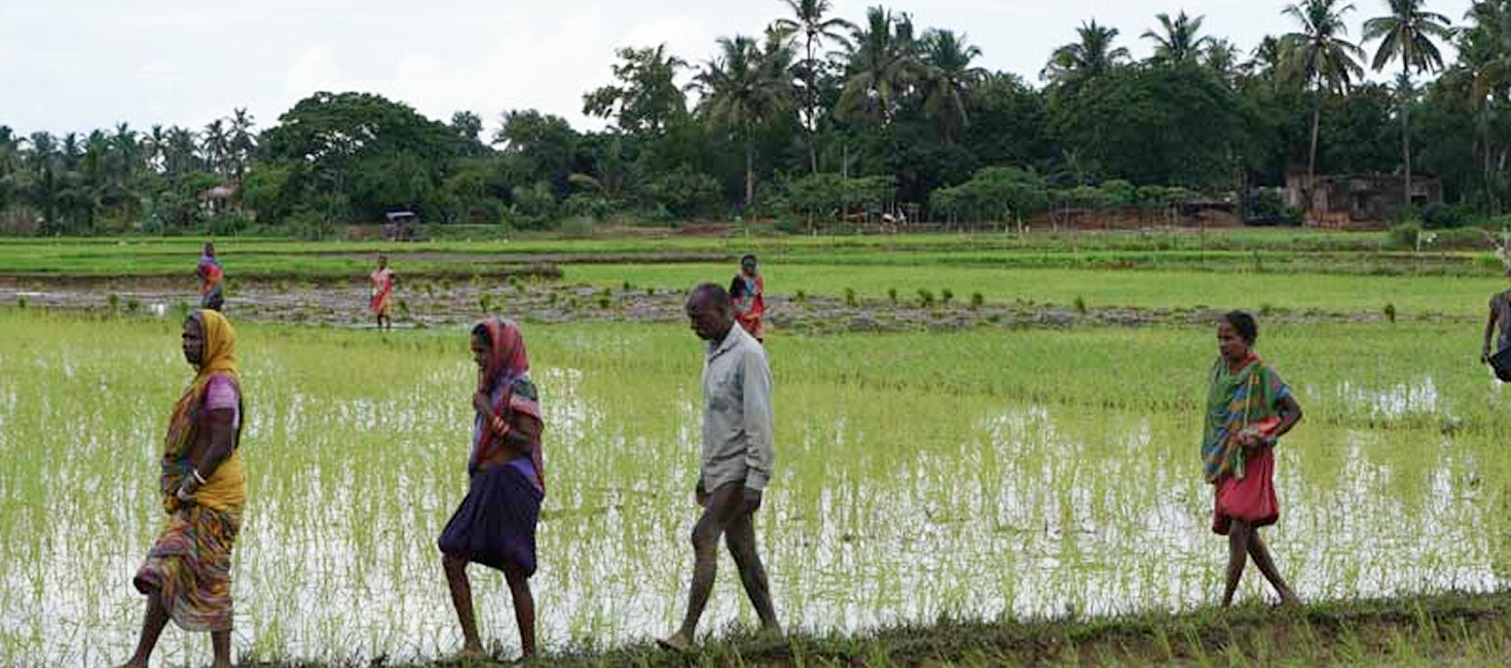


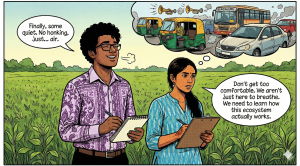
The road to Kanakapura leaves behind the relentless hustle of Bengaluru, and the landscape shifts to a serene green that hides a quiet, urgent struggle beneath the surface.
As Program Associates for monitoring, evaluation, and learning and new team members of the Community Action Collaborative (CAC) team, we undertook this field visit, not just to observe, but to understand resilience from a grassroots perspective. CAC is dedicated to building household resilience through collaborative action.
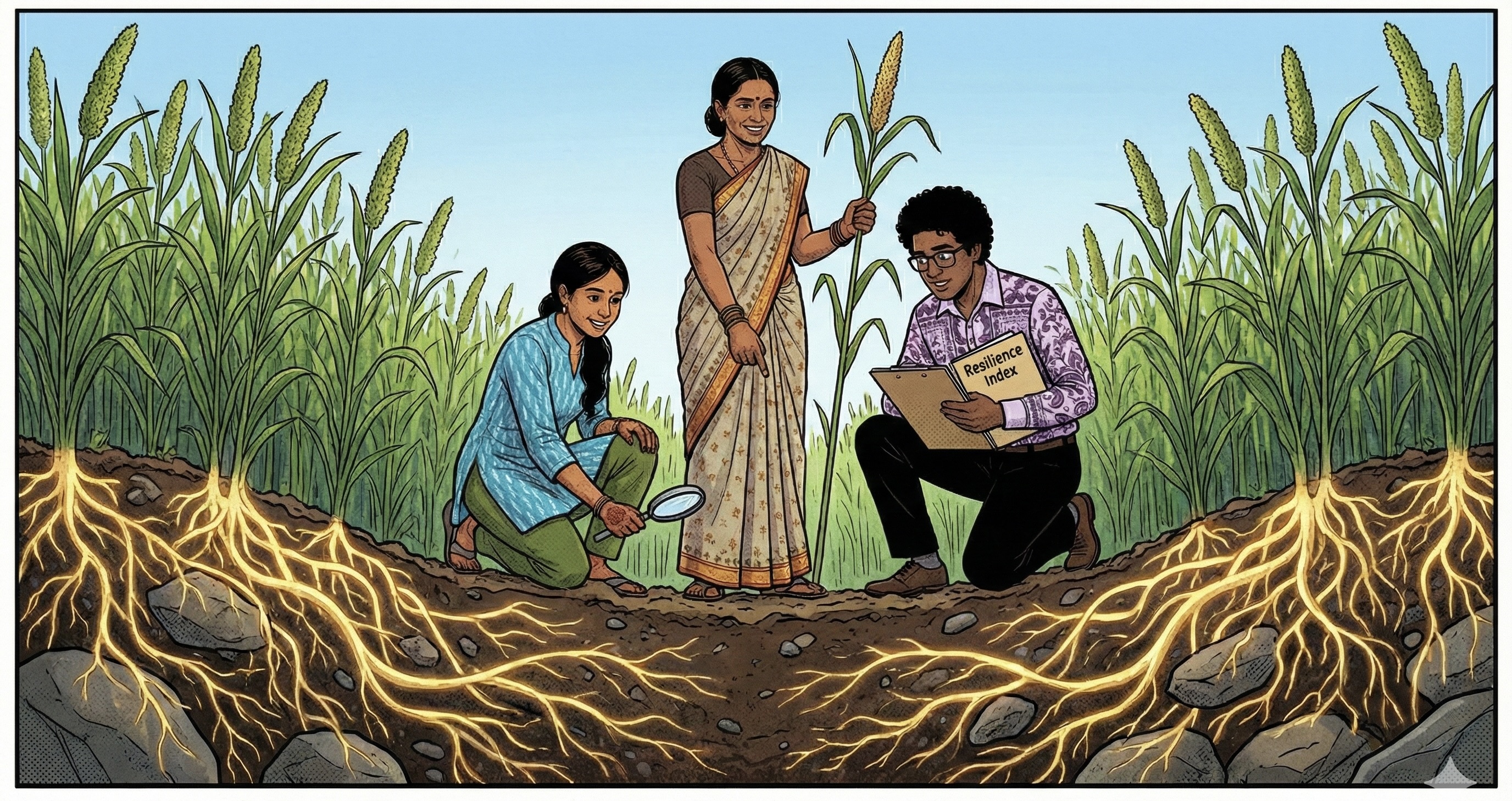
CAC defines resilience not just as bouncing back, but as the capability of a system to ‘regenerate, prosper and improve when exposed to shocks’. We went to see what that concept looks like in the dirt, sweat, and laughter of a farmer’s life.
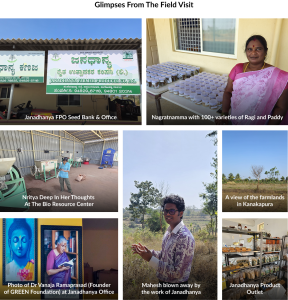
We were here to visit Janadhanya, a Farmers’ Producer Organisation (FPO) that represents the heartbeat of this resilience. Nurtured by the GREEN Foundation’s vision of intergenerational ecological security, Janadhanya embodies this movement.
Their mission: The preservation of traditional seed varieties.
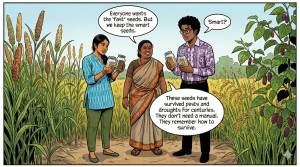
In a world racing towards high-yield, chemically dependent monocultures, Janadhanya is protecting indigenous seeds that are naturally climate-adaptable and organic. They understand that true resilience starts with the seed, using varieties that have survived local pests and droughts for centuries.
How Seed Sovereignty Builds Resilience
Here is how this ‘source code’ of tradition translates into tangible resilience for the farmer:
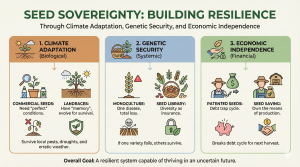
Climate Adaptation (Biological): Commercial seeds are often bred for ‘ideal’ conditions, requiring expensive synthetic inputs. In contrast, Janadhanya’s landraces have evolved over generations. They don’t need a manual; they remember how to survive Kanakapura’s specific droughts and pests.
Genetic Security (Systemic): Relying on a single variety is a recipe for disaster; a single disease could wipe out a harvest. Seed sovereignty promotes genetic diversity. It ensures that if one variety fails, the farmer has others in their ‘seed library’ that can resist, preventing total failure.
Economic Independence (Financial): Perhaps most importantly, resilience is economic. When farmers are forced to buy patented ‘terminator’ seeds every year, they are trapped in a cycle of debt. By saving their own seeds, Janadhanya’s farmers step outside this system, ensuring that even if global supply chains break or prices spike, they still have the power to plant the next year’s crop.
The “High” of Chemical Farming vs. The Reality of Soil
The deeper we dug into our conversations, the more we realized that resilience is literally a matter of the earth beneath our feet. Nagratnamma, the President of Janadhanya, pinpointed the crisis with startling precision:
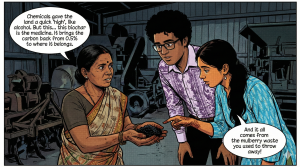
“In a healthy ecosystem, soil organic carbon should be around 10%. But here in Kanakapura, our testing reveals it is hovering at a desperate 0.5%.“
When we asked why the land had reached this breaking point, she used a chilling metaphor that perfectly illustrates a system nearing collapse: “Chemical farming is like drinking alcohol. When you drink at first, you get high, the crops grow fast, they look bright. But eventually, the crash comes, and the body, the land, is left exhausted.“
The land is tired, but Janadhanya’s solution is a masterclass in Adaptive Capacity. They looked at the local silk-dominated economy and found an answer in the waste. Instead of discarding mulberry stalks, they are transforming them into Biochar, literally sequestering carbon back into the earth to wake the soil up from its chemical “hangover.”
Intergenerational Equity: The Soil is the Legacy
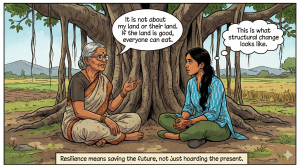
Sustained resilience is about looking beyond the current harvest. Nagratnamma shared a philosophy that perfectly sums up the community’s approach to intergenerational equity.
She challenged the old notion of merely holding onto property for the next generation without caring for its quality. She told us: “You are starving yourself by not selling the land so your children can have it… but what is the use if the land cannot sprout the seed?”
It was a stark reminder: A dead asset is no inheritance at all.
Building an Economic Safety Net (Absorptive Capacity)
Ecological idealism is expensive. A hard truth we encountered was this: “If 100% of income is dependent on agriculture, people don’t want to risk going Organic.“
To build Absorptive Capacity, the ability to cope with known shocks like crop failure or price drops, Janadhanya and GREEN Foundation facilitated the creation of Producer Groups. They set up food processing mills and diverse business units.
This effectively creates a financial safety net. It allows farmers the breathing room to experiment with the soil without the fear of total ruin. They are no longer just growing raw materials; they are processing and selling, adding value at the village level.
The Gender Shift: Transformative Capacity
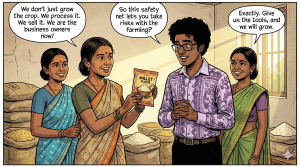
The most powerful form of resilience we witnessed was social. This is Transformative Capacity, creating fundamental changes in structural conditions, such as social and gender norms.
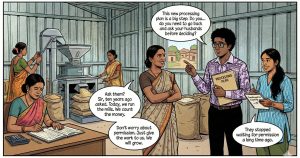
We heard stories of a generational shift. In the past, the arrival of a new opportunity was often met with hesitation, a need to seek advice or permission before stepping forward. However, through the engagement of multiple organisations, these women have founded and now operate their own enterprises. This structural shift has instilled a profound confidence to not only accept new opportunities but to actively assess and shape them.
Through the formation of Producer Groups like the Annapoorna Producer Group, the narrative has flipped. Women are now running processing mills and managing finances. Today, the response to a new challenge is immediate and assertive: “Give it to us, we will grow.” They are no longer waiting for permission to be resilient.
The Shift from Dependency to Agency
Nagratnamma’s insights provided the perfect lens through which to view the ecosystem we had just witnessed. Reflecting on the evolution of Janadhanya, she shared a deeply felt analogy that captured the shift from dependency to agency:
“In a wedding, people take more food than they can eat, and much of it goes to waste. But in a hotel, they order only what they need and finish every bite.”
Through this analogy, Nagratnamma explained how, for decades, Janadhanya had followed a “wedding” model, offering a fixed buffet of aid regardless of individual needs or capacities. Now, informed by their own experiential learning and the CAC Resilience approach, they have transitioned to a “hotel” model in practice. We saw this “hotel” model in action: a system focused not only on identifying what is missing from one’s own life to achieve resilience, but also on enabling individuals to make informed choices about what they need.
This approach brings the CAC’s framework of Sense -> Make Sense -> Learn to Act to life as a literal “hotel menu” in practice. Rather than receiving generic aid, farmers first “sense” and “make sense” of their own resilience by evaluating specific indicators like soil health or debt levels. Once they have identified their unique gaps, effectively “ordering” exactly what they need, they “learn to act,” accessing the specific solutions or services tailored to their personal context.
We find this shift from “service delivery” to “resilience facilitation” fascinating; it moves the needle from dependence to autonomy, empowering farmers to take full ownership of their own growth.

The comic images in this post were generated with the help of Gemini 3 Pro AI.
The transition from vulnerability to agency is a path many communities are now walking. To learn more about how the Community Action Collaborative is supporting families as they lead their own change, explore a deeper look at the resilience journey here.
About the Authors: